.jpg)
.jpg)
.jpg)
.jpg)
.jpg)
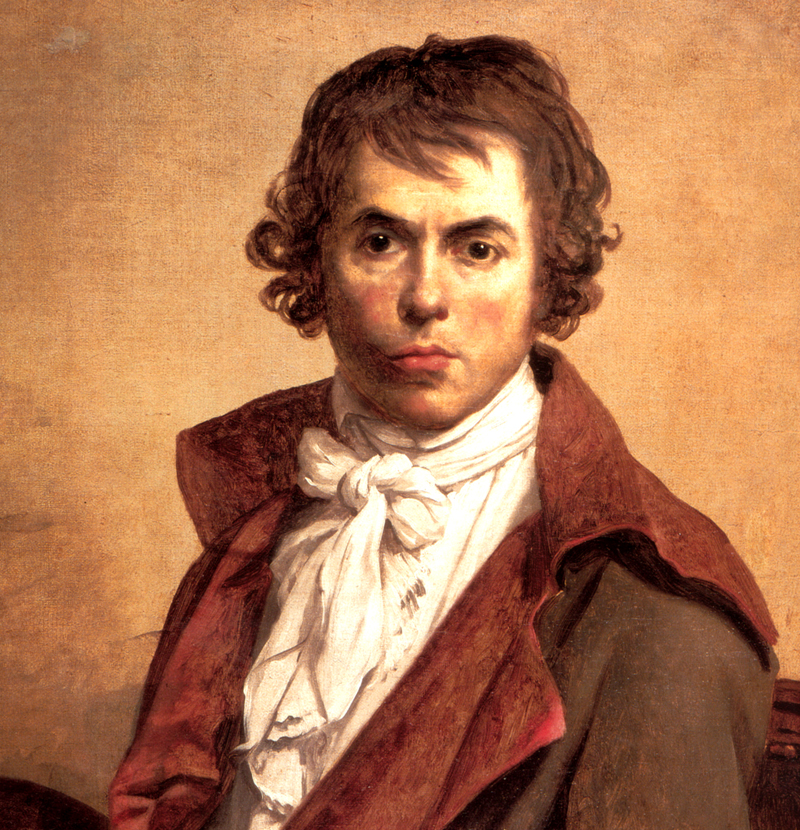
Jaques-Louis David
August 30, 1748, Paris, France – December 29, 1825, Brussels, Belgium
♦ The Assassination of Marat (1793) ♦
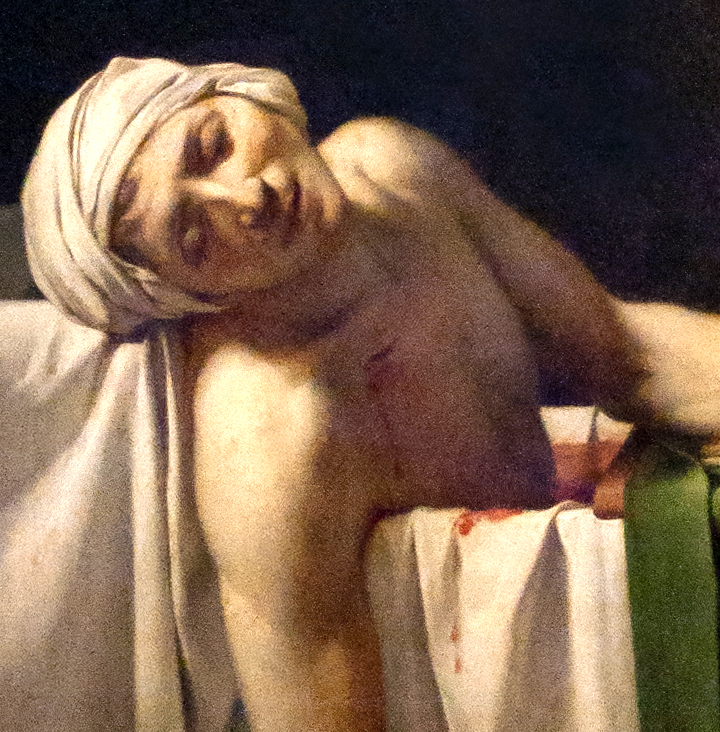
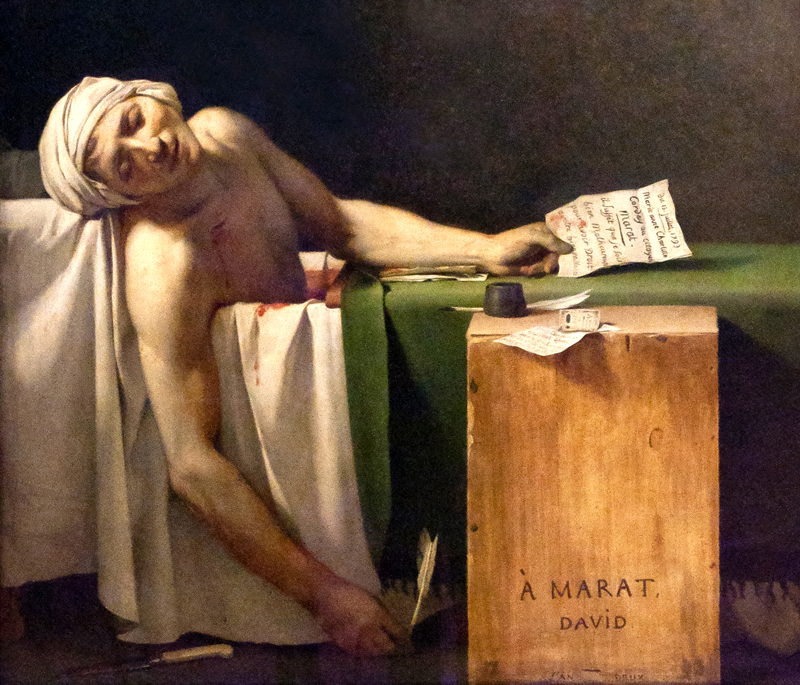
This painting is also known as The Pietà of the Revolution. The divine journalist Marat, with one hand hanging over the edge of his bathtub, loosely holding his last pen, his chest pierced by the sacrilegious wound, has just breathed his last breath.
On the green writing desk placed in front of him on the bathtub, he is still holding the treacherous letter addressed to citoyen Marat with his other hand: ‘It suffices that I am unhappy to be entitled to your benevolence’.
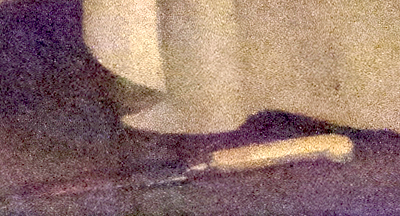
The water in the bathtub is reddened by blood, and there are also bloodstains on the paper. On the floor lies a large kitchen knife that still smells of blood. On a shabby packing crate that served as a desk for the tireless journalist, we read, To Marat, David.
♦ Diagnosis
Main symptoms: Stab wound under the right collarbone, red blood flow, rapid death.
Secondary symptoms: Male, 50 years old, journalist, leader of the French Revolution
Clinical diagnosis: Pneumothorax, arterial bleeding, hemothorax, collapsed lung.
♦ Definition: pneumothorax
The presence of air or gas in the lung cavity. This occurs in perforating wounds in the chest, either accidental or surgical, due to a tear, abscess, or hole in the lung, or due to the rupture of an air sac or bronchiole. Pneumothorax can also occur during careful acupuncture treatment in the chest area.
♦ Definition: hemothorax
Accumulation of blood in the lung cavity.
♦ Discussion:
Pneumothorax and hemothorax not only cause the underlying lung to collapse completely, but also cause a large shift in the middle section of the chest cavity, compressing the other lung.
This type of pneumothorax is usually referred to as tension pneumothorax. It is an acute medical emergency and leads to rapid death.
Marat was pursued by the Girondins and was forced to flee to England twice, where he hid in cellars and sewers. There he eventually contracted a skin disease that caused him such unbearable itching that he could only find relief by immersing himself in a bath. There he wrote, took care of his affairs, and ultimately met his death.
The Death of Marat was painted in 1793, shortly after the revolutionary leader was assassinated by Charlotte Corday. This Pietà of the Revolution, as the painting was called, is widely regarded as David's masterpiece. It is a fine example of how neoclassicism, under the pressure of pure emotion, can be transformed into tragic realism.
Jean-Paul Marat, born in 1743 in Boudy, came from a Spanish family (Les Mara) who had to flee to Switzerland because of their religion. Marat studied medicine in Toulouse and Bordeaux and traveled to England and the Netherlands. In 1789, he sided with the Revolution in France and gained considerable influence through his newspaper Le Publiciste Parisien, which later became L'ami du Peuple.
He was assassinated in 1793 by Charlotte Corday. The girl was born in Normandy in 1768 into an impoverished noble family in Caen. Influenced by Girondist refugees in Normandy, who were in conflict with the Jacobins, she became convinced that she could save France by assassinating Marat. She traveled to Paris in disguise and carried out her plan by stabbing Marat in his bath on July 13, 1793. She was sentenced to death for this and beheaded four days later, on July 17.
The painter Jacques-Louis David had visited his sick friend Marat just one day before the murder. In the early years of the Revolution, David was a member of the extremist Jacobin group led by Robespierre. He was an energetic example of a politically engaged artist. He was elected to the National Convention in 1792, just in time to vote for the execution of Louis XVI. In 1793, as a member of the art commission, he was the virtual art dictator of France and was given the nickname ‘The Robespierre of the brush’.
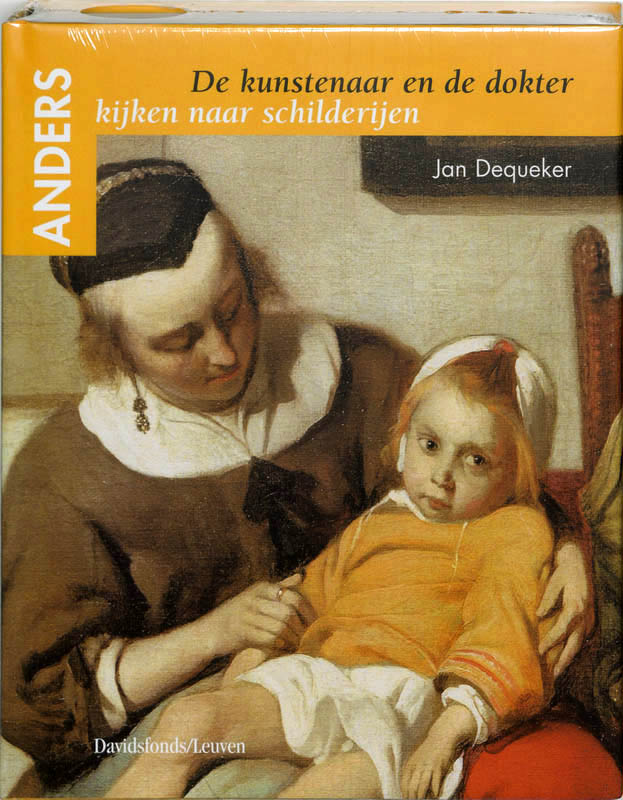
Source: Jan Dequeker

Murder (pneumothorax, arterial bleeding)
References
Jan Dequeker
The artist and the doctor are looking at paintings.
Photos
wikipedia.org
wikimedia.org
Art lijst
Schilderijen
- Bosch, Hieronymus – The Peddler
- Bosch, Hieronymus_The Haywain triptych
- Botticelli, Sandro_Primavera / Spring
- Brueghel the Elder, Pieter – The Tower of Babel
- Campin, Robert — Mérode Triptych
- Courbet, Gustave_The painters Studio
- Dali, Salvadore_The Temptation of Saint Anthony
- Dou, Gerard_the Quack Doctor
- Eyck van Barthélemy_Still life with books
- Fra Angelico_Annunciation
- Géricault, Théodore_Medusas raft
- Magritte, Rene_Prohibited to depict
- Matsys, Quinten_The money changer and his wife
- Memling, Hans_Two horses in a landscape
- Picasso, Pablo_Guernica
- Rembrandt_Abraham and the Three Angels
- Rembrandt_Elsje Christiaens
- Unknown – 16th century: Four depictions of a physician
- Velazquez, Diego_Las Meninas
Schilderijen en de dokter
- Agenesia Sacrale (a rare congenital disorder in which the fetal development of the lower spine)
- Alopecia areata (hair loss)
- Arthrogryposis congenita (birth defect, joints contracted)
- Artritis psoriatica (inflammatory disease of the joint)
- Artritis reumatoïde
- Breast development (delayed)
- Bubonic plague
- Dental caries
- Diphtheria
- Eye surgery
- Flat foot and Pointed Foot
- Fungal disease_Favus
- Gigantism and Acromegaly
- Goiter (struma)
- Hare lip (cheiloschisis) / cleft palate
- Herpes zoster (shingles)
- Hunger edema
- Influenza Epidemic of 1858
- Insanity - Malle Babbe (1640)
- Leprosy
- Lovesick, pregnancy
- Lymph node tumor (lymphoma), non-Hodgkin
- Manic Depression Psychosis
- Measles / Rubella? (acute viral infection)
- Melanoma or nevus (birthmark)
- Membranous glomerulonephritis
- Murder (pneumothorax, arterial bleeding)
- Neurofibromatosis
- Osteoarthritis / hallux valgus
- Osteomyelitis
- Otitis media (acute middle ear infection)
- Parotitis (mumps)
- Polio
- Prepatellar bursitis
- Progeria
- Pseudohermafroditism
- Pseudopregnancy
- Psychoneurosis (acute)
- Rachitic chest
- Rheumatic fever (acute)
- Rhinophyma and rosacea_depression
- Rhinophyma or bulbous nose
- Rhinoscleroma
- Syphilis (hard chancre)
- The Extraction of the Stone of Madness
- Tuberculose long
- Ziekte van Paget
Schilders
Historie lijst
- 1632-1723_Antonie van Leeuwenhoek
- 1749-1823_Edward Jenner
- 1818-1865_Ignaz Semmelweis
- 1822-1895_Louis Pasteur
Wetenswaardigheden lijst
- 1887 Psychiatric Hospital
- Animals on duty
- Bizarre advice for parents
- Bloodletting
- Bloodthirsty Hungarian Countess Elizabeth Báthory (1560–1614)
- Butler escaped punishment three times.
- Dance mania / Saint Vitus Dance
- Doctors’ advice did more harm than good
- French Revolution Louis XVI
- Frontal syndrome (Phineas Gage)
- Heart disease (Egyptian princess)
- Ice Age (minor)_1300-1850
- Ivan IV de Verschrikkelijke (1530-1584)
- Kindermishandeling
- Koketteren met koningin Victoria
- Koningin door huidcrème vergiftigd
- Kraambedpsychose (Margery Kempe)
- Massacre in Beirut
- ME stonden bol van de seks
- Mummie bij de dokter
- Plee, Gemak of Kakstoel
- Prostaatkanker (mummie)
- Sexhandel in Londen
- Swaddling baby
- Syfilis was in de mode
- Testikels opofferen
- Tropische ziekten werden veroveraars fataal
- Vrouwen als beul in WOII
- Wie mooi wil zijn moet pijn lijden
- Zonnekoning woonde in een zwijnenstal